

Key takeaways
- The connection request still gets accepted. The pitch inside it doesn't get answered, so stop using the note to sell.
- Warm people up first. A useful comment on their post makes your name familiar before your request arrives.
- Choose people by fit and timing, not list size. A short list of people who are active right now beats a long list of job titles.
- Use AI for research and drafting, and keep a person on the send. Buyers judge AI-written messages harshly once they can tell.
- Treat your LinkedIn profile as your reputation. Slow, relevant, approved outreach protects it; volume doesn't.
The connection request still works. The note inside it doesn't.
That's the clearest thing the 2026 data says about LinkedIn outreach. An industry study tracked 13.2 million LinkedIn connection requests sent between May 2025 and April 2026. About 28.5% were accepted, which held roughly steady. But replies to the note attached to the request fell from 3.5% to 2.2% over the same year, a drop of more than a third.
People are still saying yes to connecting. They've stopped answering the pitch.
So the outreach that works in 2027 isn't a better template. It's a different order of events: be relevant before you're visible, be visible before you ask, and ask only the people who fit. Below are seven strategies built on that, plus what to stop doing.
The people and companies in the examples are fictional.
What changed in 2026
Three things changed. Plan for them, not for the LinkedIn of 2023.
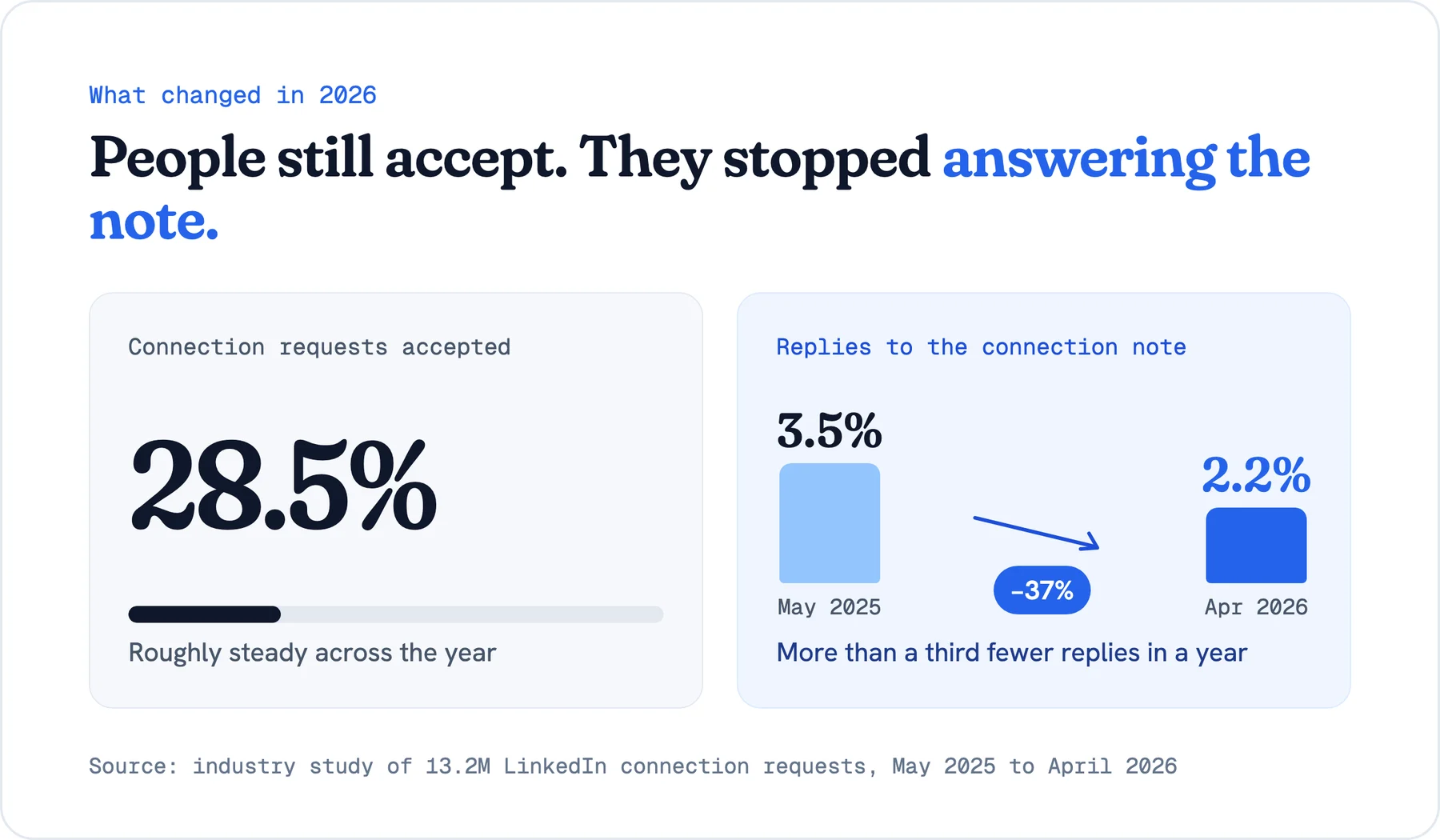
The pitch moved out of the note. Treat one study as directional, but it matches what most people see in their own inbox: acceptances hold, while replies to a cold note fall. One likely reason is that most notes now read the same, whether a person or a tool wrote them.
LinkedIn got stricter about automation. LinkedIn's own help pages say it doesn't allow third-party software or browser extensions that scrape or automate activity, and that accounts using them can be restricted. Through 2026, outreach blogs reported a wave of enforcement aimed at automation vendors as well as their users. Whatever tool you use, your profile carries the risk.
Buyers want fewer sales conversations, and they punish lazy ones. In Gartner's 2025 sales survey, 61% of B2B buyers said they prefer a rep-free buying experience. In its 2026 follow-up, that figure rose to 67%. Meanwhile, a University of Michigan study of more than 1,300 adults, published in April 2026, found that people rarely spot AI-written messages on their own. Once they're told a message was written by AI, though, they describe the sender as "lazy" and "insincere".
Put together: fewer people want to talk to a seller, and the ones who do can tell when you didn't try.
1. Engage before you pitch
The most reliable change you can make is to stop opening with a message.
Before you connect with someone, spend a few days in their feed. React to a post. Leave a comment that adds something, a question, a counterpoint, or a detail from your own work, with no pitch attached. When your request arrives, you're not a stranger. You're the person from Tuesday's comments.
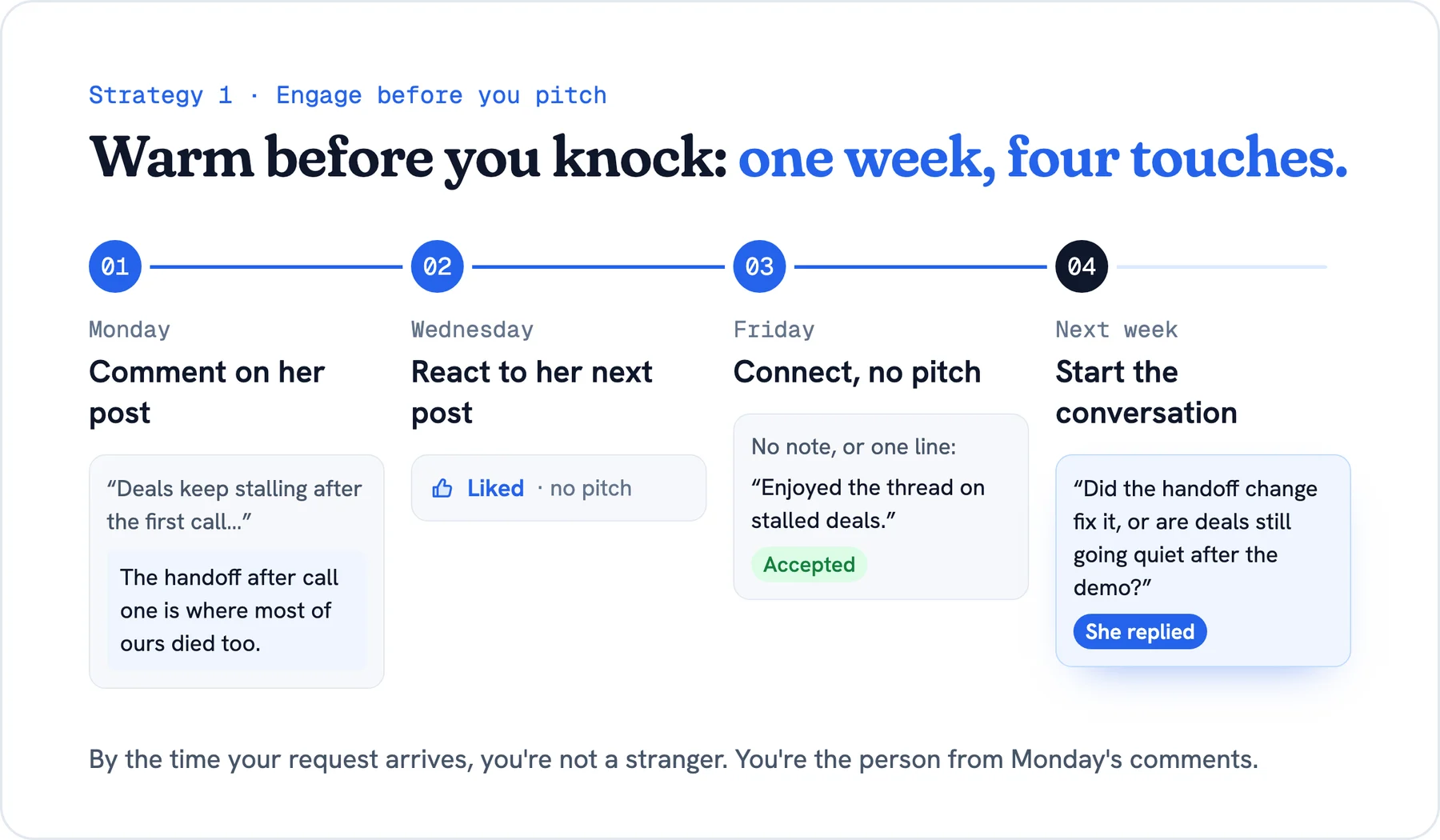
Imagine Emily, a VP of Sales, posts that deals keep stalling after the first call. You comment with what you've seen cause it. Two days later you react to her next post. On Friday you send a connection request with no note, or a one-line note about that thread. When she accepts and you message her, it's a continuation, not an interruption.
Industry data points the same way: campaigns that combine warm-up steps with outreach beat cold-only campaigns on both acceptance and replies. It lines up with how people behave: we answer people we've seen before.
The cost is time. Warming up takes days, not seconds, so it only works if you're picky about who gets it. That's the next strategy.
2. Choose people by fit and timing, not by list size
A list of 2,000 "Heads of Sales at SaaS companies" isn't a strategy. It's a guess about who might care.
In 2027, build your list from two filters:
- Fit: do they match your ideal customer on the things that predict a purchase, such as role, company size, industry and what they're responsible for? Be able to say why, in one line, for every person.
- Timing: is there a sign they're thinking about the problem now? Good signals on LinkedIn are concrete: they posted about the problem you solve, they commented on a competitor's post, they started a new role, or their team is hiring for the job your product helps with.
A person who fits and has a reason to care this month is worth ten who only match the job title. It also makes everything after this easier, because you already know what to say.
If you work with a fit score, insist on seeing the reason behind it. "Fit 91" tells you nothing. "Decision-maker at a 120-person B2B SaaS company, posting about stalled deals" tells you who to write to and what to write about.
3. Stop selling in the connection note
If replies to notes are falling while acceptances hold, the note is the wrong place to make your case.
You have three better options:
- No note at all, when you've already engaged with their posts. Your name is familiar, so the request speaks for itself.
- A one-line note that references something they said. "Your post on deals stalling after call one was spot on" is enough. No ask.
- A note with a reason to connect that isn't about you, such as a shared event, a mutual connection, or a thread you were both part of.
Then hold the first real message until after they accept, and make it about them. The conversation starts there, not in a 300-character box they read in two seconds.
4. Write from evidence, not merge fields
"Hi {first_name}, I came across your profile and would love to connect" was never personal. In 2027 it's also recognisable as automated, which costs you more than silence.
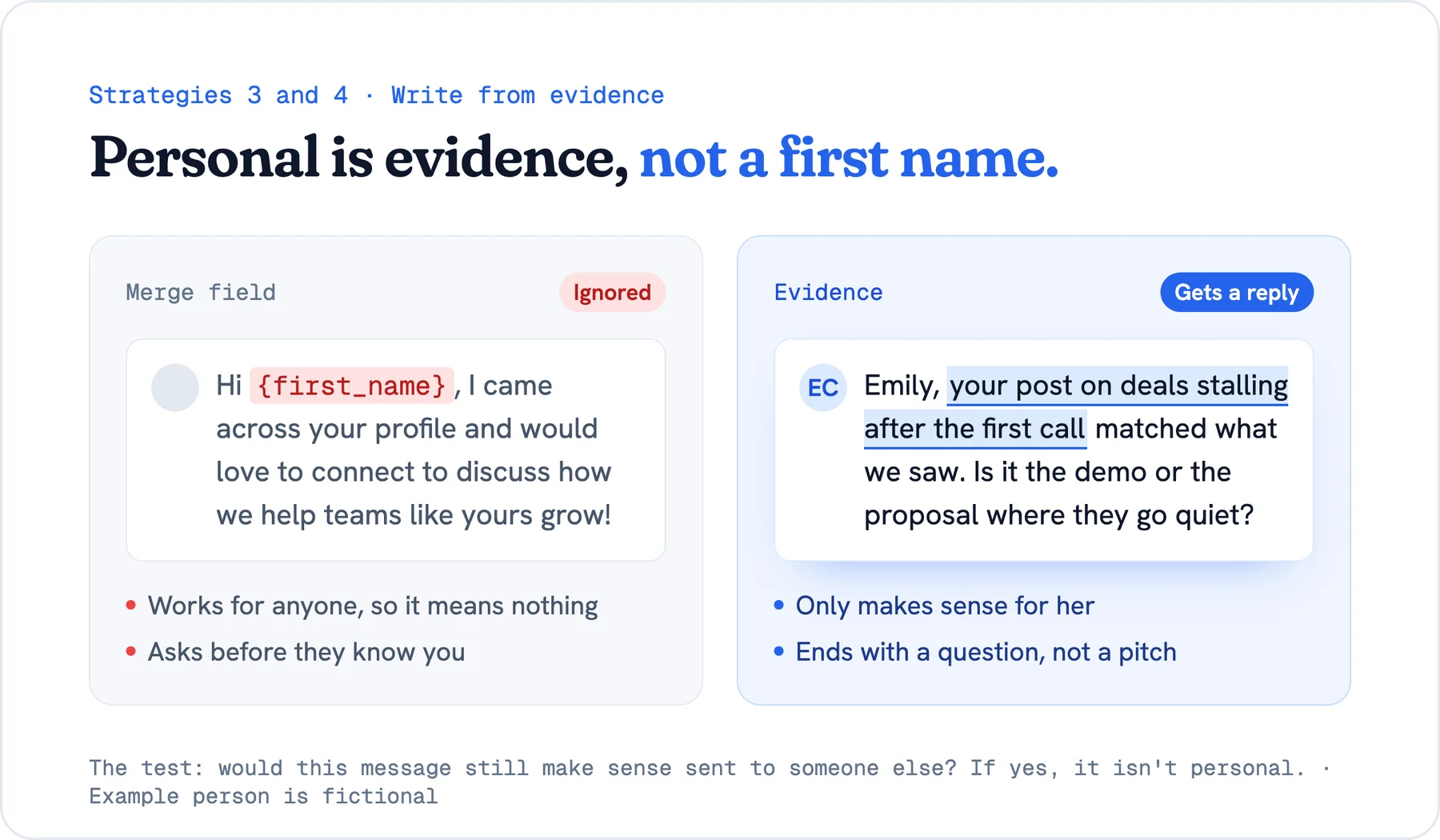
Personalisation that works is evidence: a specific thing the person said, did or is dealing with, and a reason your message is relevant to it. A useful test is whether the message would still make sense if you sent it to someone else. If it would, it isn't personal.
The best source is their own words, and it's what drafts grounded in their posts should start from. Their recent posts, their comments on other people's posts, and how they describe their role all tell you what they care about this quarter. Company news is useful too, but people respond more to their own words than to their company's press release.
Keep it short. One observation, one question, no pitch until they show interest.
5. Let AI do the work, and keep a person on the send
AI is now good at the slow parts of outreach: researching a person, scoring fit, summarising what they've posted, drafting a first version of a message. Using it for that is simply sensible.
The risk is letting it send on its own. The Michigan study explains why: people can't easily tell a message was AI-written, but when they notice, they judge the sender harshly. One generic or wrong message from your profile, sent at 2 a.m. to someone who matters, costs more than the time you saved.
The approach that holds up into 2027 splits the job:
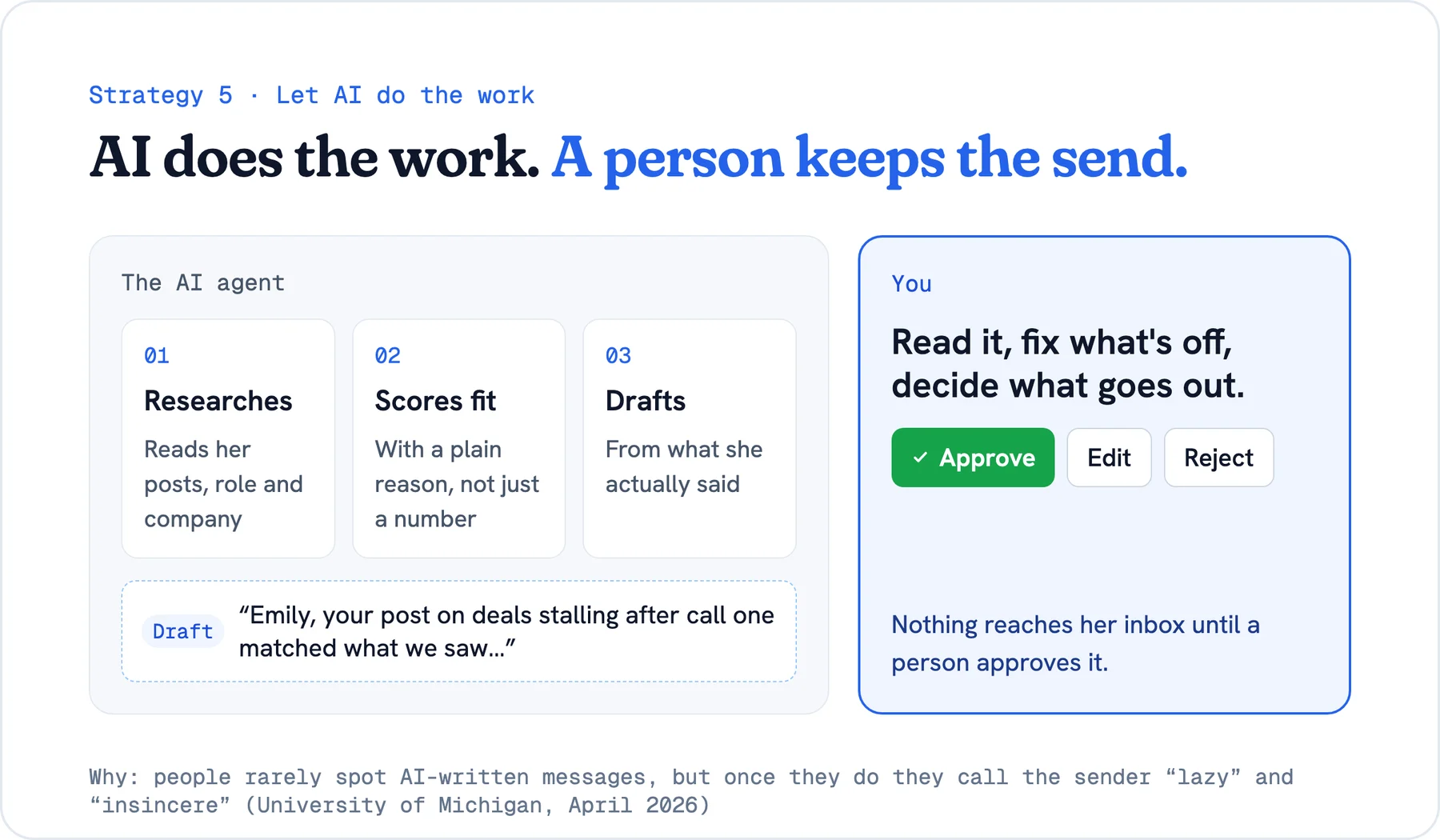
- AI researches and drafts. It reads their posts, checks the fit, and writes a first version grounded in what they said.
- A person approves. You read each draft, fix what's off, and decide what goes out. With good drafts, that takes seconds per message, not minutes.
- The AI learns your edits. Over time the drafts need fewer changes, which is how the work gets faster without getting careless.
This is also the honest answer to "should I use an AI SDR?" Use AI for the work. Keep your name on the decisions.
This is the approach Orbitmate is built around: agents find people who fit, engage with what they post, and draft from what they said, and nothing goes out until someone on your team approves it. Start with your website and see the first drafts before anything is sent.
6. Follow up by adding something, across channels
Most follow-ups say "just bumping this up". In 2027, that's the message people archive without reading.
A follow-up should add something the first message didn't:
- a useful resource on the exact problem they mentioned,
- a short answer to a question they asked in a post,
- a relevant observation from a new post of theirs,
- or a clear, easy no ("If this isn't a priority this quarter, no problem, I'll leave it here").
Space them out, and stop the moment they reply. A sequence that keeps going after someone has answered is the fastest way to look automated.
Use more than one channel, with a different job for each. LinkedIn is where you get known: people can see your profile, your posts and your comments. Email suits the longer, more detailed follow-up, once there's a reason for it. Treat them as one conversation, not two separate campaigns hitting the same person.
7. Protect your account like it's your reputation
For most founders and small teams, the LinkedIn profile doing the outreach is the brand. If it gets restricted, you lose your network, your inbox and your credibility for a while.
LinkedIn doesn't publish its exact limits, and they vary by account. The habits that keep you out of trouble, and the ones worth looking for in any tool's sending controls, are about behaving like a careful person, not finding the edge of a rule:
- Go slowly, especially with a new or quiet account. Ramp up over weeks, not days.
- Keep to working hours in your own time zone. Activity at 3 a.m., every night, isn't how people use LinkedIn.
- Withdraw old, unanswered invitations instead of letting hundreds pile up.
- Only send what you'd be happy to defend. Relevance is also a safety measure: people don't report messages that are genuinely useful to them.
- Don't rent or buy accounts to get more volume. It turns your outreach into exactly the behaviour LinkedIn is looking for.
No tool, ours included, can make LinkedIn automation risk-free. Pace, relevance and a person checking what goes out lower the risk. Anyone who promises "ban-proof" is selling the thing you should be wary of.
What to stop doing in 2027
- Pitching in the connection note.
- Templates where the only personal part is the first name.
- Measuring success by acceptance rate. Acceptances are holding while replies fall, so a high acceptance rate can hide a strategy that isn't working.
- Letting an AI send from your profile without anyone reading it first.
- Buying volume with more senders or rented accounts instead of relevance.
- Follow-ups that only ask whether the last message arrived.
A weekly rhythm that puts it together
If you're doing this yourself, alongside running the company, here's a rhythm that fits into a few short sessions a week:
- Monday: choose. Pick a short list of people who fit your ideal customer and show a reason to care right now. Write one line on why each person is on the list.
- Monday to Wednesday: engage. React to and comment on their posts. Add something every time.
- Thursday: connect. Send requests with no note, or one line that references their post.
- Next week: start the conversation. Once they accept, send one short message about what they said, ending with a question.
- Week after: follow up once, with something new, on LinkedIn or by email. Then let it rest.
- Friday: review. Count replies from people who fit, not acceptances. Drop what didn't work, and keep what did.
Small and consistent beats big and occasional. A list of people you actually researched, worked through every week, will outperform a large campaign you launch once and forget.
The short answer
LinkedIn outreach in 2027 works the way good networking always has: show up where people are, add something useful, and talk to the people who have a reason to listen. The difference now is that the shortcuts stopped working. Notes don't get read, volume gets accounts restricted, and buyers can tell when nobody tried.
Use AI to do the reading and the drafting. Keep the judgement, and your name on every message, with a person.
If you want to try the warm-first approach on your own ideal customers, start with your website in Orbitmate, or book a demo and we'll walk through it with you.

